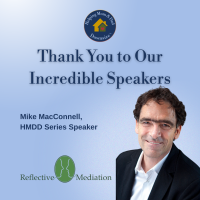
When Love and Fear Collide: Navigating Family Conversations About Downsizing - Mike MacConnell: HMDD Guest Speaker
Wednesday Feb 18th, 2026
When Love and Fear Collide: Navigating Family Conversations About Downsizing
Key Takeaways from Our Helping Mom & Dad Downsize Webinar with Mike MacConnell
One of the most powerful moments in last month’s Helping Mom & Dad Downsize webinar came during our conversation with Mike MacConnell.
Mike is an accredited family mediator specializing in intergenerational mediation.
The Real Dilemma: Stay or Move?
On the surface, the question seems practical:
Should Mom or Dad stay in the home — or move?
But as Mike so clearly explained, beneath that question lies something much deeper:
- Identity
- Autonomy
- Safety
- Stability
- Fear
- Love
For many seniors, the home isn’t just a structure. It represents who they are.
For adult children, stepping in can feel like crossing an invisible line — balancing respect for independence with concern for safety.
And when emotions run high?
Under duress, we regress.
We slip into fight, flight, or freeze.
- One sibling pushes urgently for change.
- Another resists, wanting to “honor Mom’s wishes.”
- A parent withdraws: “I’m fine. Don’t worry about me.”
- Or becomes defensive and angry.
Sound familiar?
This is not dysfunction.
It’s human nature under stress.
The Emotional Hijack
Mike spoke about something called “emotional hijack” — when fear overrides the rational part of our brain.
When we’re overwhelmed:
- We rush decisions.
- Or avoid them entirely.
- We argue positions instead of exploring perspectives.
- Old sibling dynamics resurface.
And here’s the key:
Most families are not actually disagreeing about values.
They’re disagreeing about solutions.
One child prioritizes autonomy.
Another prioritizes safety.
But no one is against autonomy.
No one is against safety.
When we move the conversation from positions (“She has to move!” / “She’s staying!”) to values (“I’m scared she’ll fall.” / “I don’t want her to feel controlled.”), something shifts.
We realize:
We are on the same team.
Team Mom.
Team Dad.
Team Love.
Start With Yourself
One of the most grounding messages Mike shared was this:
The shift must begin with you.
Before having the conversation with a parent or sibling, regulate yourself.
Calm your nervous system.
Take a breath.
Go for a walk.
Journal.
Pray.
Meditate.
Have tea.
Because who you are in the conversation speaks louder than the words you use.
If you enter in fear, you’ll get fear back.
If you enter with curiosity, you’ll open doors.
Lead With Curiosity, Not Control
Instead of saying:
“You need to move.”
Try:
“Help me understand what staying here means to you.”
Instead of:
“This isn’t safe anymore.”
Try:
“What worries you most about changing things?”
Curiosity disarms defensiveness.
And here’s the powerful part Mike emphasized:
When we ask why a solution matters to someone, we uncover the values beneath it.
And values are almost always shared.
That shared ground becomes the foundation for collaboration.
Widen the Circle
Isolation is common in these situations.
Each person sits in their own bubble of fear, guilt, or frustration.
Mike encouraged families to widen the circle:
- Involve siblings early.
- Bring in neutral professionals.
- Invite outside facilitators if needed.
Sometimes decades of family history make it hard to hear one another clearly.
A neutral third party can:
- Balance power dynamics
- Lower emotional temperature
- Ensure every voice is heard
- Keep discussions focused on solutions
And most importantly — help families move forward instead of spinning in old patterns.
Make Decisions Before Crisis Makes Them For You
This message echoed throughout the webinar.
If decisions happen after:
- A fall down the stairs
- A hospital discharge
- A sudden diagnosis
Options shrink dramatically.
Consensus becomes harder.
Stress multiplies.
Regret creeps in.
But when conversations begin early — even casually — families can:
- Explore options slowly
- Visit communities without pressure
- Consider home modifications thoughtfully
- Align around a shared vision
Planning does not eliminate emotion.
But it does reduce panic.
Love Is the Guiding Principle
At one point in our discussion, I noticed something.
We had talked about logistics.
We had talked about fear.
We had talked about safety.
But the word that hadn’t been spoken yet was:
Love.
And that’s what this is.
Every tense conversation.
Every disagreement.
Every sleepless night.
It’s rooted in love.
When we remember that — when we truly anchor in that — we shift from opposition to partnership.
We stop arguing.
We start listening.
This Is a Process, Not an Event
Mike reminded us that meaningful decisions rarely happen in one meeting.
First conversation: share perspectives.
Second conversation: reflect and process.
Third conversation: begin narrowing options.
Processing takes time.
And that’s okay.
In fact, it’s necessary.
The Takeaway
Downsizing conversations are not just about houses.
They are about:
- Identity
- Autonomy
- Safety
- Family history
- Shared values
- And love
If your family feels stuck, stalled, or strained — it may not be about the decision itself.
It may be about how the conversation is happening.
Start with curiosity.
Ground yourself first.
Widen the circle.
Focus on shared values.
And most importantly — remember you are on the same team.
If last month’s webinar taught us anything, it’s this:
The earlier we talk,
The calmer we decide,
And the stronger we stay — together
Thank you to our Helping Mom & Dad Guest Speaker Mike, for his amazing wisdom.


Post a comment